Seven times seven (Part 1)

I like what the bible does with sevens.  I’ll split this into 2 posts.

See where it starts – a creation week in Genesis.  We jump straight in to that week right at the start – on the first day of there week Spirit and Word come together and speak light into the creation

 And God said, “Let there be light,” and there was light.  God saw that the light was good, and he separated the light from the darkness.  God called the light “day,” and the darkness he called “night.” And there was evening, and there was morning—the first day.

Geneis 1:3-5

And that week of sevens, ends with a creation wide instantiation of rest.

Thus the heavens and the earth were completed in all their vast array.

By the seventh day God had finished the work he had been doing; so on the seventh day he rested from all his work. Then God blessed the seventh day and made it holy, because on it he rested from all the work of creating that he had done.

Genesis 2:1-3

The next seven is less happy

Cain has killed his brother, after being jealous and angry about being cautioned over his sacrifice, and is expelled from Garden. He is now worried that  he too will be killed.  But he is given this stern word of protection and warning:

But the Lord said to him, “Not so; anyone who kills Cain will suffer vengeance seven times over.” Then the Lord put a mark on Cain so that no one who found him would kill him.

Genesis 4:15-16


The next seven is even less good.  Cain, newly expelled, starts building a city, and also has a child.

“Cain was then building a city, and he named it after his son Enoch. 

Genesis 4:17

It’s a sad statement.  It prefigures so many of the works of man, attempting to recapture something lost in the garden, building our own ideas of legacy. Warping the potential of creativity and reproduction for our own ends.

And in that family line things will  get 7 times worse.

Ina verse or two, we zip down Cain’s family tree to the 7th generation, to Lamech, and sevens are now multiplied.

Lamech has mimics and abuses the word that was over Cain, his ancestor:

Lamech says :

I have killed a man for wounding me,
    a young man for injuring me.
 If Cain is avenged seven times,
    then Lamech seventy-seven times

Genesis 4:28

Vengeance in his own hands. Arrogance. Self righteous. A tyrant, passing off iniquity as strength.

( We also hear Lamech married two women – the first time we hear of that breaking in. We get a glimpse of other arts in their children as well – music, metalworking, agridculture – peraps hinting of more creation domains that will be tained with self will )

So the 7 fold fullness of where that line has gone – ever since the wrong sacrifice back at Cain, has lead to more willfulness, rebellion. 

The narrative reboots – we go back to Adam and Eve’s next child, Seth, the child born after Abel’s death. This will be better. Before we get the line, we hear:

“ At that time people began to call on the name of the Lord.”

Genesis 4:26

This leads to a better 7.

We run down Seth’s line to Enoch, who stands as the 7th generation from creation, as a  descendant from Seth.

And in the 7th generation of this line, there I a much better intsnefication of walking with God.

That is a good and wonderful intensification of sevens.

After he became the father of Methuselah, Enoch walked faithfully with God 300 years and had other sons and daughters.  Altogether, Enoch lived a total of 365 years.  Enoch walked faithfully with God; then he was no more, because God took him away.

Genesis 5:22

A couple of generations after him there is a another, better Lamech, the father of Noah.  This side of the family is also delaing with the curse on the ground of the fallen creation, but not in such rebellion.

When Lamech had lived 182 years, he had a son.  He named him Noah and said, “He will comfort us in the labor and painful toil of our hands caused by the ground the Lord has cursed.” After Noah was born, Lamech lived 595 years and had other sons and daughters. Altogether, Lamech lived a total of 777 years, and then he died.

Genesis 5:28-31

Notice we end of with a 777 as if to emphasise the signal – that’s all the fullness of that genealogy for now. Part two.

—————————————————

Postscript : Notes and Connections
Skip this the remainder if you just want more on the sevens. Part two is here:

But if interested, a few follup connections that can be interesting.

Literal or Symbolic
A supplementary question that might occur now:  how literal is all this?
Well.. that’s often a modern concern but not really the right question to ask.

If we want to take the bible seriously, then arguing about if it is literal, or fits science, etc,  is often distorting things – adding categories that do not immediately come out of the text. 

We should instead learn and ponder the meaning of what it actually says. At least make sure we do that first before making it part of another discussion.

Second Supplementary question: Summarise what it means so far.

God made the heavens and the earth; and the creation week is a primary structure.   

The sevens also track and underline developments of the two genealogies that emerge after the fall; a redemptive line, and a deteriorating line.  One starts with the calling on the name of the Lord, the other builds a city named after his son. The progress at the 7th generation is intentionally contrasted – Lamech, who is taking vengeance in his own hands, seven times seven, and Enoch, walking with God.

(There is an Enoch and a Lamech in each line, just to keep us on our toes in reading)

City of Man
Later theology also starts to contrast the city of man, that Cain starts (and Babel etc), and Zion, that is ultimately the city above. Good gifts are still seen to come through the lessor line, but may be contaminated, orientated against the real source. See Heb 11:8-10. -Abraham leaves one to seek the other.

Enoch
Enoch is a bigger figure than we see here. He skips death, after all. For a fuller development of Enoch see the book of 1 Enoch . And also the book of Jubilees and 1 Enoch,. Both of those expand on his role and retell Genesis with emphasis on the fallen angelic hinted at in Genesis 6. But handle with care – these texts are ruled as not canonical (apocryphal) although it seems clear the New Testament writers knew of them (1 Enoch is quoted in Jude 1:14 and there are other hints). He is still coming and going from Eden.

Transfiguration
I think it is likely the transfiguration of Jesus took place at Mt Hermon, highest city in the region. It’s then partly to reclaim the place of the angelic breach named in those texts, and being transfigured there is partly to seal, to cleanse and reorder our proper orientation to the heavens with him as King,. Against the fallen ones who would misuse creation gifts and wisdom to take humanity astray. (Healing arts, art of war, metal working, arts of seduction, are all named in those texts as improperly given). But that’s another story.

Creation groans?

There are those who have something “akin to a religious experience” in the wonders, or mysteries, of nature. So experiencing a beautiful sunset,  staring up at the night sky, holding a new born baby, all tend to do this, at least some of the time.  The recipient might not have a full sense of who they are grateful to, might run around the hospital thanking staff for a gift they didn’t exactly give, but they know something of the experience calls to their depths.

Bigger frames emerge, a sense of wholeness, meaning, gratitude and joy. Astronauts also seem to commonly report that sense when they look down on the whole planet – seeing with fresh eyes the sphere we live on, all in one vision.

And here, we have to acknowledge something fundamental, both obvious and difficult. That is, experience changes us.`I like the Avatar film for that picture – you see the marine, a dutiful soldier, gradually awakening to the wonder of the new planet he is immersed on, drawn to its people.  His military buddies think he has “gone native” and reckon him as the enemy.  Some of the attitudes he used to have, have dissolved.  Some new senses have opened.

My daughter showed me a video they watched in biology, of David Attenborough – producing something of a final testament; a witness statement to his life’s work and the state of the world as he sees it.  (A life on our planet)

Like most of us, I’ve watched his work on and off over the years, admiring the footage and his wonder, and almost comically earnest, boyish manner.

He is something like, in my view, the father with a new born, finding wonder in creation, and also finding pain – the increasing crisis of habitat destruction – and not sure what to do with either.

He talks of  great trauma and loss as he watches the planet suffer degradation, loss of biodiversity, as its species suffer. And against this grim picture, he sees hope we can still change things.

He doesn’t align either of those elements, the wonder, the damage, the hope, into any narrative of creation, or fall, or sense of new creation. He says somewhere that nature is too violent for him to see God in it.

But he is not consistent – he might not believe, but he does borrow from a religious framework.  He looks at pre-industrial society as more in touch with nature – more of a “garden of Eden” stage, in his words.  He speaks of evolution’s “talent for design”. These phrases hardly square with what a strict atheist might be expected to say –it’s not a disinterested view of a meaningless creation. He also wants to say humanity is culpable of mismanagement.

So these feelings are a bit out of focus – inconsistent both with his atheism and with a full theistic understanding of where humanity has gone wrong. But like many of his age, he seems to borrow, almost unconsciously, from some of that religious framework, uses it for moral and existential resonance even while not fully owning it, or explicitly fighting it.

So what can we say of his passionate concerns? Does theology just censure the great naturalist for not subscribing to a decent doctrine of creation. Surely there is something in his life’s work, exploring the wonders of creation and its suffering.

Can we not agree with those who see the planet suffering and groaning? 

So, a question. Don’t we also know that creation is groaning?  Take the apostle Paul, in the midst of explaining the new creation state in the believing heart, in Romans 8. There is more happening there than just our new Spirit experience as Christ rescues us from sin, powerful as all that is. The implications of what is started and coming are creation wide.

So Paul, already experiencing the powerful first fruits of the redemptive Spirit, says he groans alongside creation (Romans 8) as he, and it, wait for a greater freedom.

We know that the whole creation has been groaning as in the pains of childbirth right up to the present time. Not only so, but we ourselves, who have the firstfruits of the Spirit, groan inwardly as we wait eagerly for our adoption to sonship, the redemption of our bodies. For in this hope we were saved.  But hope that is seen is no hope at all.( Who hopes for what they already have?

Romans 8:22-25

What time line is this? Well, whatever it is, it is parallel to Paul’s current experience – still groaning inwardly even though he has received the Spirit that enacts the freedom him from sin and death. (“no condemnation for those who are in Christ Jesus, who walk by the Spirit” 8:1). And then he chooses a widening of the lens to the say the whole of creation is groaning right at that point.

He doesn’t forget Genesis as the big picture, when he talks of spiritual experience. It’s all still connected.

This wider lens occurs just when it seems his focus has got quite personal, an introspective look at “me and God and the law” in the preceding chapter, and “jews and gentiles” before that. And just when it seems to centre on a new personal experience in Christ , it suddenly opens up to creation wide discussion. He knows the big picture starts with Genesis.

I wonder if a firm “military” understanding of the church will think this discussion is going native, or green, or some other term, here. But, if so, one can only reply that experience changes things. Experience of how the creation is groaning, waiting, to know the reconciliation.

One example – I was quite moved as we watched some whales approach the boat we were on, in Queensland recently. You can’t put it in words, except to say, watching the curious creatures,  so massive and sentient, is something like staring at the stars. A sense of wonder,  an integrative view just emerges, for many.  So some in our group laughed in joy and wonder, while others were also half suffused in tears,  as these huge animals rose so near to us, tracking alongside the boat for hours. On some days enough trust builds in both direction that people swim with them.

And to think that particular species (humpback) was hunted to near extinction, and their numbers have now come back, as one of the great success stories of the ecological movement, was also moving.  So watching half a dozen of these young males skite along beside us, with dolphins circling alongside, is moving in ways you can’t quite name. The whales travel thousands of miles a year, with complex songs communicating – and the dolphins seemed to be playing, an event that looked like curiosity on all sides, as three species all watched each other, curiously, cautiously.

We would do well, I think, to have a philosophy and hopefully a theology that can hold all this.  We might picture ourselves on the Titanic, scrambling aboard salvation life boats – to use a  common image. But we should be careful not to imply too much – or too little – here, as if to say who cares about the natural world, or anything else,  when it’s all going down, or burning up. That reduction is only useful insofar as we urge the necessary steps aboard – and in that moment, we do have to grapple with choosing a narrow way apart from the vanity of all else.

But taking that essential moment of rescue as the single lens on everything, is too simplistic. We need a proper grounding in the goodness of creation as well, or it can lead to poor thinking. In these polarised times we sometimes see suspicion towards those who have felt the wounding of nature more deeply than we have. “You care more about trees than people’s souls, <or this other hot button issue>” is sometimes the accusation. But it is not a very useful critique. We shouldn’t have to rank things like that; both those who sense the urgency of the human drama and those who feel the cry of creation, have a piece of the story.  The salvation metaphors should tell us the ark has room for both. The animals also came aboard, if we want to use that urgent rescue image.

The groaning creation is waiting, according to Romans, for redeemed ones to come forth.

18 I consider that our present sufferings are not worth comparing with the glory that will be revealed in us. For the creation waits in eager expectation for the children of God to be revealed. For the creation was subjected to frustration, not by its own choice, but by the will of the one who subjected it, in hope  that the creation itself will be liberated from its bondage to decay and brought into the freedom and glory of the children of God

Roman 8:18-21

It’s not clear to me exactly how the resets and redemptions and resurrections will occur as the promised new age is brought to fullness. I’m not convinced the details of that hope aren’t surrounded in some mystery, to be approached in faith, but more on that anon.

But our basic sense of both wonder and compassion hints that that there is bigger picture at work than just being taken out of creation. All things are made through him, and for him, and are redeemed in him.  So, the gospel urges us to enter the new creation that starts around Jesus’ death and resurrection. But the good news echoes to the whole creation. We should pick that up as well, have something in common in those who start by lamenting that deep groaning as well.  And instead of waiting for the new heavens before we do anything to address this, to speak and see reconciliation here as well, consider – maybe Revelation doesn’t exactly encourage that. It does give a warning of “destroying those who destroy the earth”. (11:18)” And Paul, rejoicing in the Spirit as Christ makes him free, still knows creation groans, and that something of the (coming ?) glory of God in us is meant to answer that cry. Maybe that only culminates in a future era and state. But seems it also starts now, as surely as the Spirit is given and the new creation starts to come forth in us.

(For an academic theology of this, Jurgen Moltmann was here by 1973 – and deeply orthodox in the usual sense, not that I have read too much of him.)

Creation-Cross-New Creation

So, on Sunday, in the worship, I got some quickening on a stream of thoughts, about creation and the cross.

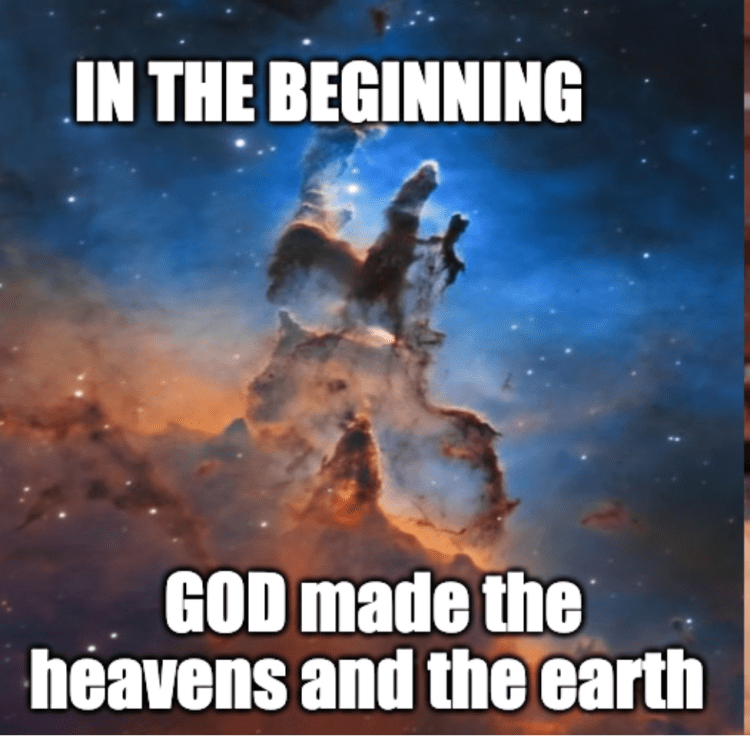
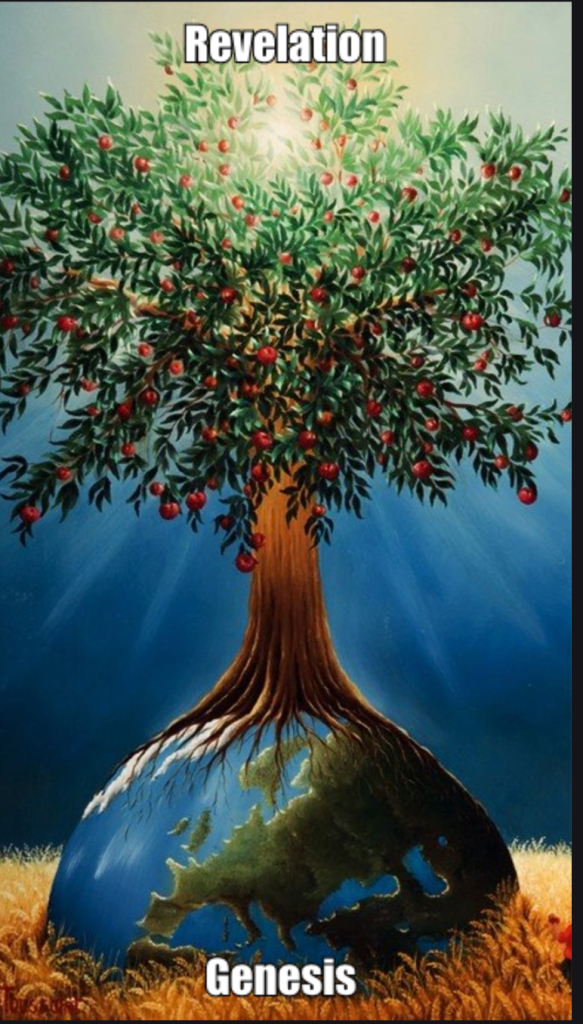
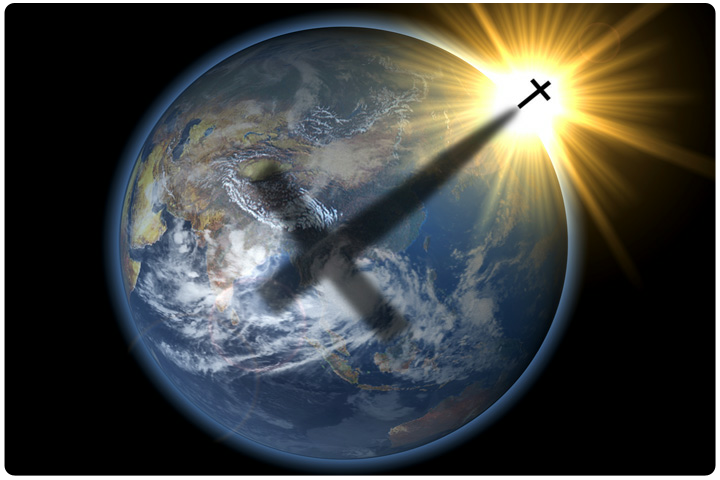
It’s too long, so I’ll add a meme or two to tee up the thinking.

In certain sense, the story of the bible goes like:

* Creation. 
* Cross.
* New Creation

Others would say, with more detail:    

* Creation
* Fall
* Israel
* Jesus  – Cross and Resurrection
* Church  
* New Creation

There are things to learn from both views.  The longer one shows more facets of Jesus
(we see the Great Prophet Moses spoke of,  the true kingly son of David, the true Lamb that fulfills all sacrifice,  and the great High priest. And we start to see the personification of Yahwew. ) And when God is a character in a story, He is in it, and beyond, authoring it.

But the simpler, 3 fold, version, Creation.Cross. New Creation does something equally useful. In pruning out the history of Israel it emphasises something very powerful about the beginning and the end.

Creation to the Cross is the first half of the bible. Resurrection to the New Creation, is the second.

We see Jesus as the second Adam – redeeming the whole creation – fulfilling purposes originally conceived in the Garden. There is a symmetry to this approach – we first see the tree of life at the very start, in Genesis 2, and the very end Revelation 21 – John knows he is writing a bookend to Genesis, the new heaven and a new earth.

Christianity does not start with the Cross – except in the mystical sense of the Lamb being slain before the foundation of the world.  But the cross is not the first element in our story. It is wrapped in the middle of two creation narratives.

One could open the bible to show that, andI will approach the Gospel of John, but first, let’s approach it via another path.

Take, if you will, Narnia, with its Christ figure, Aslan, who spans creation and redemption. 

Don’t  be put off by the childlike side of this – CS Lewis was drawing on deeper insights.

If we theologise the Narnia story a little, no doubt there is some sense in imagining Aslan always foresaw the need to die for Narnia, knew from the beginning that the error that let evil in, would fall on him. You see him knowing that, in fact, as he confronts the first child about how a witch has been allowed in the new world. And it is implied that some aspect of the story is prewritten in the letters of creation, the Emperor’s “Deepest Magic” which touches on the mystery of  sacrifice.

 But in getting to that difficult part,– we must still come through the story, through the adventures, the gradual exploration of the land, its noble people and creatures first.  

So Narnia is loved for its creation, its song and nobility, its wonder and characters, before its difficult parables of sacrifice are fleshed out. Evil is an interloper, a thing that might not have been.  And we are caught up in the story, almost without it.  We resonate as Aslan sings it all into being. Or later, see the delight of Lucy,  recapturing the trust and boldness of an innocent child.

There are early hints that Aslan will deal with the witch who has bound the land in endless winter,  will cause a new spring to come forth, will bring the frozen wastes into new bloom. And will also rescue the traitorous brother who is more deeply bound than he knew, or meant to become. 

But it is also a creation-wide redemption, and we hear of that first – the promise of the endless winter breaking. The new jovial Christmas figure.

The account of redemption is key.   But if the story, or cinema version, was to cut too quickly to the sacrifice, it would risk making that world no more than a setting for the stone table, and we would lose something of the scope, of what it achieves. We need to see the weight of the created order, to really value the weight of that redemption.  The goodness of the world is more than the terrible path Aslan walks, though it is reduced to that brutal logic, for one day.  The reward is more than Edmund returned to sanity, and to his family; it also the freedom of the whole land, and the reversal of the stony deadness of all the prisoners. It is the proper rule over the whole land, kings reigning properly, and the whole world now rejoicing in spring. We undermine the meaning, cut short the proper telling, if we do not see that that whole frame.

That willingness to sacrifice might underpin all that is good and noble, all that is true,  in Narnia and indeed our world. 

 But it is wrapped in a double creation.


So to query Narnia for meaning again – and it is better just to read it as a story rather than mine it for these snippets – consider its end story; The Last Battle. As the whole world ends,  falls to wrack and ruin at the end of days, the world ends, yet the chronicle does not end. After the world is wrapped up, through the darkness, through a dark door, comes a world rekindled. A new Narnia, or something very like it, but greater, is given. It as if all is resurrected within the goodness of a deeper frame. All the loved ones again known in one new timeline; all journey deeper in,  a journey to the heart of goodness that has always been there. 

Sacrifice is not just at the stone table. It is hidden in the nobility of being willing to serve and stand for what is right.  It may be embedded in the path of honour – not the pride of saving face, but of protecting the good, of treating even the (human) enemy fairly,. Sacrifice comes by growing in true discipline, being on the right path, doing the right thing, discarding the false,  fighting for what is right, and serving what is good.  And the rolling currents of joy and goodness follow.

All of that, draws from the heart of self-surrender – and the deeper price which restores honour where it has been lost.

So, from the parable to the bible.

Our own divine prehistory knows a garden, a paradise, Eden, before it knows a fall. 

We come via the creation days of a seven fold blessing, the repeated statement that creation is Good and very Good, and that rest remained on all.

So we see the themes of work and discovery in the garden, tasks of naming and tending. We see the gift of God’s presence waxing and waning, His presence intensifying in the cool of the evening.  The garden sketches a vision of growth, of stewardship, of exploration.

And we must hear and ponder that creation-wide blessing and potential.

All of that, before the fall, before the fatal conversation with the serpent, before the prophecy of the heel being struck as the enemy’s head is crushed.

We may have served the witch, or the serpent, in one way or another. We may have become stricken, helpless as that heavy price of redemption fell on Another, in freeing us.  

But nonetheless, let us also honour the wonder and promise of the new creation which is always intended. All things are made through Him, and for Him, things on heaven and on earth.  All structures, all thrones, all dominions.  

So, hear the gospel of John.  John knows he is writing scripture – he starts his gospel by quoting Genesis.  “In the beginning”.  –

Just starting with that, we know this is not just a salvation of souls story,  It a new creation story.

 Thus, he starts, as I do here, by skipping over Israel, and orients us the original creation narrative, the days which set up realms and rulers. All that comes back in view. The word, he says, is behind all that is made:

In the beginning was the Word, and the Word was with God, and the Word was God.  He was with God in the beginning. Through him all things were made; without him nothing was made that has been made. In him was life, and that life was the light of all mankind.  The light shines in the darkness, and the darkness has not overcome it.

John 1 (Genesis 1?)

So, later, in this gospel account, when Jesus is raised, how does John describe it:

“Early on the first day of the week, while it was still dark,….”

This point is not that Mary got up early, or that it was dark before dawn that Sunday.  It’s about new creation again coming out of the darkness. Another first day, another new creation week starting out of the preceding darkness.

“…..Mary Magdalene went to the tomb”

So what of her first encounter with the Lord?  John says she mistakes him for the gardener– that is the first perception of risen Lord.

“thinking he was the gardener, she said …”

 What is John doing with that “mistake.” Well,  is the right mistake to make, a hint of the new Eden, as the tomb opens to a new garden of creation.

Just pondering that terrible sacrifice, by faith, made for us, redeems. But let us also see from it the new creation, opening the new Eden, the new gardens, new oaks of righteousness, the new arrays. well-tended hearts flowering in a profusion of goodness.


If we catch this, I think we can place many other things properly in our own world. We are less likely to fall into a spiritual / secular division. The word of work, for example, sits better with that larger frame. That’s a whole topic in itself, but rather than splitting things into spiritual and secular, we can see that many things matter, can be places of growth and training. Similarly we won’t pitch science versus faith – another big topic, but science is hinted at in the garden, naming the animals, working the ground.

So work and worship, family and love, wisdom and learning, discipline and training, outreach and growth, are all structured around this account of creation. It is all redeemed and renewed around sacrifice. And that heart of sacrifice is embedded in it all, is the key playing out part, for others. And that comes from the King’s heart of sacrifice.

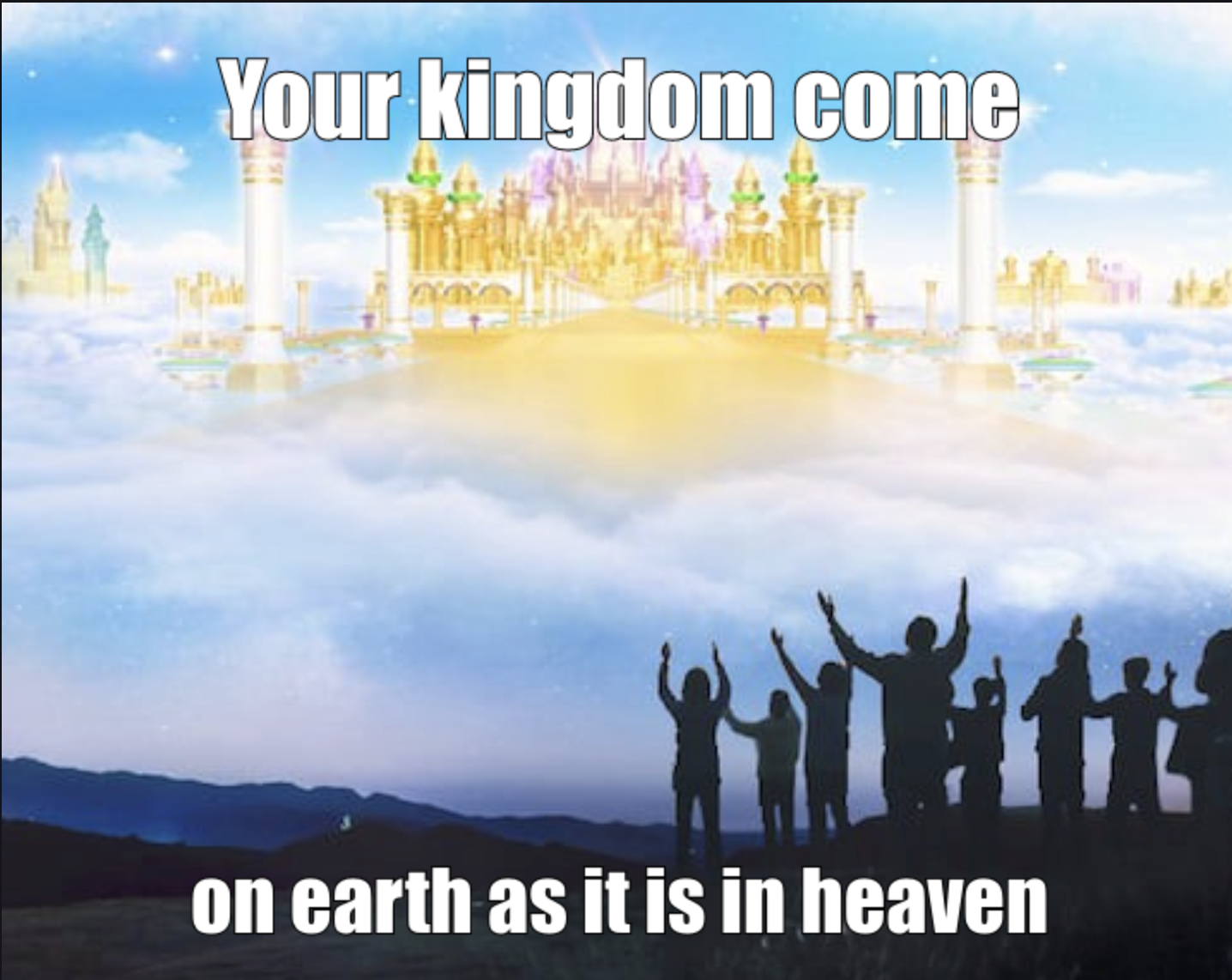
All of that creation frame, ordered correctly, distributed through hearts that welcome him, becomes the kingdom. The kingdom comes in each of these realms; the kingdoms of the world become the kingdom of God; transformed through His people.


Next post (?) :

What does Paul mean when he says. “creation groans … waiting to come into the glorious liberty of the sons of God”. The frozen, bruised, winter of the land, the injury of the fall, groans as it waits for us to carry the love God forth. 

How do we participate?

And maybe, shiver, time for some end times.

Coffee in the mall

This is a discussion. Its for a few reasons.  Up front I want to name them:

  • Writing helps me stabilize and deepen, by naming some things. 
  • Illustrate something of the sense of listening to God – the different texture it gives to reality and the inner world.
  • Fills in some perspective, from the partially activated mandates of 2017, to where we are now, in 2021.  That cycle has come around again.
  • Helps others understand something of the spiritual battle we are in.

Its also partly addressed to a friend, who knows those some of those things; so is a useful figure to frame it up for.   I guess because there is some common story, some shared metaphysical furniture, so to speak.

So, local friend. I  had a dream the night before i saw you. I saw a figure who I knew was Darth Vader, but also looked like an aging rock star; scrawny Mick Jagger like; bare skinny arms hinting at abuse. I knew this Vader / decrepit rockstar wanted to try to rule from a hidden position, and he said to someone else with a nod: “we rule the galaxies between us”, then stepped back into a hidden place, a place high above. The dream didn’t seem to disclose who he proposed as a coequal, just that it all felt decrepit, cunning, evil in high places.

So, this morning, I was sitting in Chancery Lane having morning coffee after dropping daughter to school. I like Chancery Lane and its arty cafes – have made creative videos for work there, and had some recent God moments there.

But this morning I hear a song, and it feels laden with something, a wounded complaint. “I’ll never be your beast of burden … ain’t i rough enough …..ain’t I tough enough”. ( I don’t realise till later its the Rolling Stones, which later recalled the Vader / Jagger figure)

We’re stepping into a  somewhat heightened state where details are more meaningful – movig into some deeper waters in the nightly worship meetings, and a clarity comes where one sees and senses more.  These times can be cyclical on a couple of scales – individually it may be  easier to tune in on a day off work.  Corporately we’ve been here before as a group; that wave is rising again. Such times can also be progressive, building over months and years – as each grows in hearing and sensitivity

“I had with a sense your spirit was dancing as I woke”, said my wife, earlier this week. Next morning I woke with something similar, a Lionel Ritchie song, “Dancing on the ceiling”, surfacing from forgotten memory into a dream, then echoing into the waking state. And a dream sense of painting the sky.  

Today, having coffee,  the wrought iron gates to Chancery lane, adorned in ivy style, near El Gordo look slightly serpentine; and I feel like I’m listening to the complaints of the principality being given its marching orders to leave from the town. We’ve touched this in the recent intercessory surge as well. Named some of what people sense as opposition.

Who was Nimrod ? A mighty warrior who had kingdoms. Who is the beast? A system of rulers and kings. Who is the Queen of heaven? The one we sense as a local principality, claiming allegiances through religious misdirection. All those things have dubious, linked, provenance and are characterised by unfaithfulness. (… beast of burden song insists in gravelly tones… all i want is for you to make love to me). Such things have always wanted our heart, our partnership.  

And listening to the café music, it feels like not just hearing disconnected tunes in a cool cafe, but also hearing something of a complaint, from something over the city, now being rejected, divorced.  The beast of burden song gives way to a self pitying complaint (If tomorrow never comes) , and then a comment on megalomania (Everybody wants to rule the world), and it all somehow threads into the complaint of a jilted ruler.  

A prophetic friend said to us in 2017 as we approached a high water mark in the Spirit, listen to the music on the local radio, its all got a touch of God on it. I don’t recall if you were here then, local reader,  but it really seemed to. Those snippets of song that come into mind as one wakes  – you mentioned hearing “life goes on” as you woke after a difficult time, my “dancing on the ceiling” example, are something similar –  we’ve all learnt to listen to the waking echo of a dream as potentially holding a message to catch; given we believe a primary Word creates and sustains all things, and speaks through them. But back then was something moving more into full daylight.  More than the phrase that catches your attention, it felt everything was breaking through like that, all day long, if you paused to listen.

The term apophenia means seeing patterns that aren’t there; joining dots that should not be connected. But conversely sometimes we are opened to see things that are there, and find all sorts of things are being used to speak a present word.  And all need to weigh up what is happening, when things seems revelatory. What are idioms of Spirt we have learnt, and are learning? What is stretching us into a new mode, and as we grow, adding to what is known.

Back in that 2017 revival season, for a few weeks it felt not only that the songs were speaking, but that dreams were crossing directly over into the waking state.   Maybe it was the amount of prayer we were soaking in; but it felt like God turning up the volume.  I want to unpack that a little, as backdrop to Chancery lane this morning.

 So, a good friend  of ours was here in 2017, a missionary grounded in an indigenous  town in Central Australia,  quite a seer, and was spending a couple of years on furlough in this town.  After so many dreams and visions in our community  –hundreds and hundreds of posts shared among us a we learned to listen and decipher,  and then all rising to up to a common target together – she  had a key dream.  It was a nested dream, of three dreams within dreams, and sense of waking from one into another.   After months of intercession and listening, it felt to me like an inflection point, the point dreams were crossing into reality.  

And for me stretches of life became really started to feel like an acted parable, laden with meaning like a crafted scene in the theatre.  It was like dreams and visions surfaced everywhere, in every scene, with the same strange latency of meaning as a dream or an interactive, instructional scene.  I remember being at the market one day …I’ll hold that for story for another post maybe

One example I will list;  for a week everything my work mate said had rich double meanings, coincidentally using lots of the same symbols that we had landed on recently in the intercessory group, which he was not part of. It also happened to him a bit too – I mentioned a” json file’,  which is techie language for something we worked on, and a mutual friend called Jason walked around the corner at that instant;  making an unlikely appearance upstairs in the library. A string of similar things happened around that same day or so, and you know its more than your doing brain pattern matching when it happens – he was pinging on the oddness of it all, without me really saying anything

In the end there were so many overlaps – every second sentence seemed weighted like that. I ddn’t disclose the multiple layers that were so clear to me, but after a week asked if i could come and chat with  him and his wife –  good friends already, open to God’s current speaking,  but not quite the same church community, though we overlap a bit.  I  shared what had been happening, the parable like nature of the last week or two, and some other things; fire angels and so on.  Intrigued them into  wanting more.

 Soon after, one of the deepest nights I ever saw was at the their house …

I’ll trace that too before getting back to this morning’s coffee and the jilted power over the town. The longer background hopefully helps gives perspective.

I was little destabilized that night at their place, back in 2017, after a week of fire and rebuilding.   A visiting prophet had warned that may happen, as he opened some windows over us, but I’d missed the warning. A week of intense fire opened up, a deep reboot like I’ve never known, and being so heightened was quite destabilising for a few days. I had to lean on a friend for a few days;  getting my bearings again as the deep rebuild stabilised, and a new way of seeing opened. It happened to a few others in that season as well; 

So although quite stretched, at that house I was safe with these friends and family, and we circled around for hours, building deep and profound conversation together, with children contributing timely pieces. 

I was puzzled too,  that a key post I’d made a day before on social media, with a significant image,  just disappeared.  I went to look at it early in the evening, and it was just gone.   I wondered at how that happened – was sure I hadn’t deleted it, and it would have not have violated any policy, and there was no telltale explanatory note from any fact checkers or copyright notes etc. For me, it was rich and meaningful,  a key marker of the end of a level. It stood for something like exiting the Matrix, or at least one level of the Game of Life.  I liked the way it came together, using a visual symmetry I have a long cherished, now with people innocently commenting on the post’s outer meaning, adding a layer of detail. As  I wondered what had happened,  I “saw” the post in minds eye, fluttering up, being taken as if a treasure, in another place; like the rich, deep conversation, which unfolded directly after. 

That night I had a clear impression that we were not exactly alone,  our families and a friend, having a meal together, and a long conversation,  were somehow visible from afar.  At key points I would get a sense we were bouncing up very high as if from a trampoline, in a stadium seen by many, and the high points of that conversation seen and recorded.  I’d done some  apologising to each one present for various breaches of relational protocols – getting a deep touch from God like I had that week quickens the repentance, and knew  I had not always got the role of  father,  husband,  work colleague,  or prophetic friend, all correct That was part of the intro to our deep discussion together

The whole thing felt like a testimony being kept and stored in heaven, high points celebrated and sealed, like the post that disappeared.

 So finally coming back to today, a  similar season now opening, or restarting. Things didn’t feel  as  heightened this morning having coffee at El Gordo in chancery lane, but we’re getting there.  The season deepens.

So that’s some background to the songs of complaint, a rejected spirit over the city.

So this morning, coffee over, I decide to walk to OfficeWorks in the mall; I need to buy a USB stick for work. Nod to fellow believer I see from a distance, now serving as a city councilor.  We’ve chatted recently but not today;  he might tag all this as introspective excess, while he gets on with serving the poor. But he likes his writing too, and I respect his way, and such things can overlap.

 As i get to the store I remember OfficeWorks no longer opens to the mall. Right at that very moment the music in the mall stops, and the radio presenter says “someone has just texted in to say they think OfficeWorks should open its doors again, from the mall side”.   I feel a bit like I’m in the Truman show for a moment – how did that radio just broadcast exactly what I was doing and thinking about?  – the inconvenience of that store entrance being closed.

To add to the odd coincidence, I turn around and see that ABC radio is actually broadcasting from the mall, the presenter is sitting behind me in the open air, at a table only 30 m away;  interviewing someone, with a few techies around her.  They aren’t commenting on me, or not intentionally, which just makes it all a little more strange that they’re coincidentally narrating my experience from close by.

At the time that all mostly just felt oddly coincidental – even in a heightened state not every coincidence needs to be a God moment, though we must be open.

And perhaps it does carry more meaning– have felt something there as I pondered, in retrospect.  As Isaiah (30) says.

“Your own ears will hear him. Right behind you a voice will say, “This is the way you should go,” whether to the right or to the left.”

As to the question of whether the randomness of the radio be quickened to carry a personalised meaning? … well … that seemed to be underlined in all this.

I felt a darker irony though about what happened next. A local councillor is being interviewed by the presenter in the mall – or maybe is this the new mayor, broadcasting on the radio, about what the community can do to engage the mall etc. She talks up community partnership, not just council plans. So If Tai Chi or Moonlight Market is your flavour then come on those days. 

The irony, though, is this:  as I walk away I notice a drug deal going down. Three desperate looking young guys are sitting at the end of the mall.   One passes the other a satchel and he leafs through, inspecting the content.   I look twice and they notice.  I walk a little, wonder if I  should report it, and reflect on the irony of the ABC in the same mall, trying to talk up the mall as shopping or lifestyle option, while this is happening. The beast is not fully gone – that decrepit dark lord still has some influence.

I turn to think if should report it but two of them have already scarpered.  They looked desperate enough that I check my back, that I’m not being tailed as a I walk to the car.

So, that’s a snippet of a day off, buying morning coffee and buying a USB, in such a season; when one believes God may be speaking.  

Later that day more timely and precise things happen,  the randomness of making a simple choice to get a coffee or take a walk become sites of revelation and even more unlikely coincidence. When hearts given over to Him are bounded in goodness, the lines fall in pleasant places,  hearing the transmission of the Message that is closer than it seems.

When we are open to God; the door that opens in Jesus Christ, the ordinary has God layers.


As postscript I want to add another thing, that also happened as i walked down the mall.
A passerby made a comment on the radio, saying he used to like the older mall, but understood a lot of the expensive redesign went on hidden but necessary things like drainage works.  I’ve learnt from 2017 that the design and operation of the city space is an important sphere of public testimony that God is interested in working with, as well as all the art spaces, so I don’t dismiss all this as mundane. And remind myself of some previous keys about all this, that as He touches this city he will honour those who serve and sow to the future.   

To footnote such a story, one could say, coincidence can be part of the language of the Spirit, a sign our story is rubbing against the intent of the one who made all things, and can oversee our stories. Coincidence is not always that, and even though sometimes it needs to be resisted as other things brush up – not all co-incidence is good – yet sometimes it reveals good things, or at least revelatory doors opening.

PPS – I can imagine that some may feel – “it sounds like the author is basically sane, but I don’t love the tone of this – bit too loopy. or inclined to make mountains out of molehills”. Well, have a look at the the title piece – the idea is that prophetic pieces (which stretch) and teaching pieces (which stabliise) inform each other. This is mostly on the former side, though it does aspire to leave a trail.

PPPS. That market story. Might add.
Introduce Yourself (Example Post)

This is an example post, originally published as part of Blogging University. Enroll in one of our ten programs, and start your blog right.

You’re going to publish a post today. Don’t worry about how your blog looks. Don’t worry if you haven’t given it a name yet, or you’re feeling overwhelmed. Just click the “New Post” button, and tell us why you’re here.

Why do this?

  • Because it gives new readers context. What are you about? Why should they read your blog?
  • Because it will help you focus your own ideas about your blog and what you’d like to do with it.

The post can be short or long, a personal intro to your life or a bloggy mission statement, a manifesto for the future or a simple outline of your the types of things you hope to publish.

To help you get started, here are a few questions:

  • Why are you blogging publicly, rather than keeping a personal journal?
  • What topics do you think you’ll write about?
  • Who would you love to connect with via your blog?
  • If you blog successfully throughout the next year, what would you hope to have accomplished?

You’re not locked into any of this; one of the wonderful things about blogs is how they constantly evolve as we learn, grow, and interact with one another — but it’s good to know where and why you started, and articulating your goals may just give you a few other post ideas.

Can’t think how to get started? Just write the first thing that pops into your head. Anne Lamott, author of a book on writing we love, says that you need to give yourself permission to write a “crappy first draft”. Anne makes a great point — just start writing, and worry about editing it later.

When you’re ready to publish, give your post three to five tags that describe your blog’s focus — writing, photography, fiction, parenting, food, cars, movies, sports, whatever. These tags will help others who care about your topics find you in the Reader. Make sure one of the tags is “zerotohero,” so other new bloggers can find you, too.